Frammenti domestici tra memoria e oblioDomestic Fragments between Memory and Oblivion

1999–2001

Time leaves traces of lives lived, remembered or forgotten on domestic walls. In a home connected to a loved one, photography isolates these material marks and transforms them into presences where memory and oblivion meet.

Fine art prints on cotton paper, wooden frame and art glass. Edition of 5.

Bedroom wall bearing the trace left by a photographic portrait of my grandfather (73 × 58 cm)
Bedroom wall bearing the trace left by a photographic portrait of my grandfather (73 × 58 cm) · from the series Frammenti domestici tra memoria e oblio / Domestic Fragments between Memory and Oblivion (1999–2001)
Entrance door (25 × 20 cm)
Entrance door (25 × 20 cm) · from the series Frammenti domestici tra memoria e oblio / Domestic Fragments between Memory and Oblivion (1999–2001)
Entrance hall floor (94 × 119 cm)
Entrance hall floor (94 × 119 cm) · from the series Frammenti domestici tra memoria e oblio / Domestic Fragments between Memory and Oblivion (1999–2001)
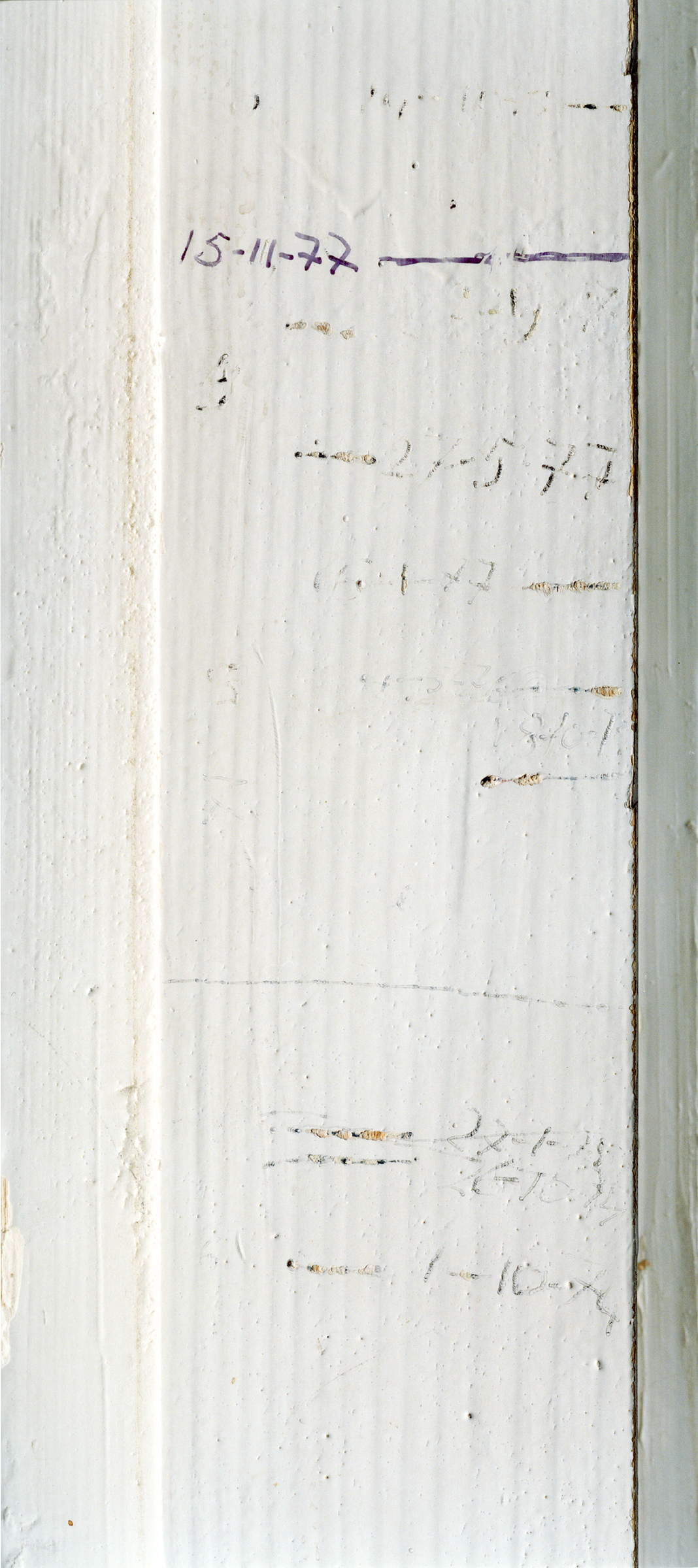
Segment no. 4 of the living-room door jamb (26 × 12 cm)
Segment no. 4 of the living-room door jamb (26 × 12 cm) · from the series Frammenti domestici tra memoria e oblio / Domestic Fragments between Memory and Oblivion (1999–2001)
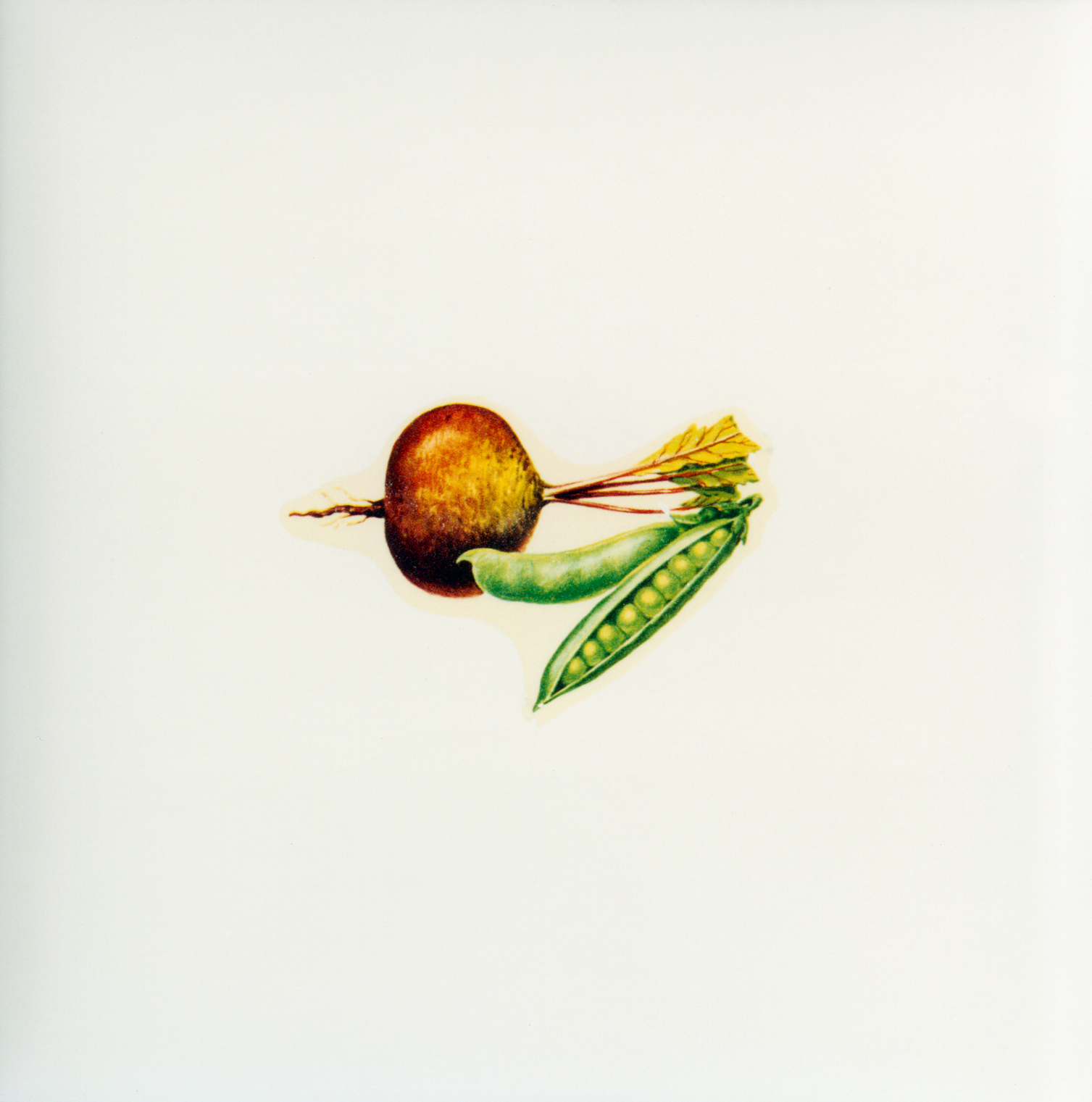
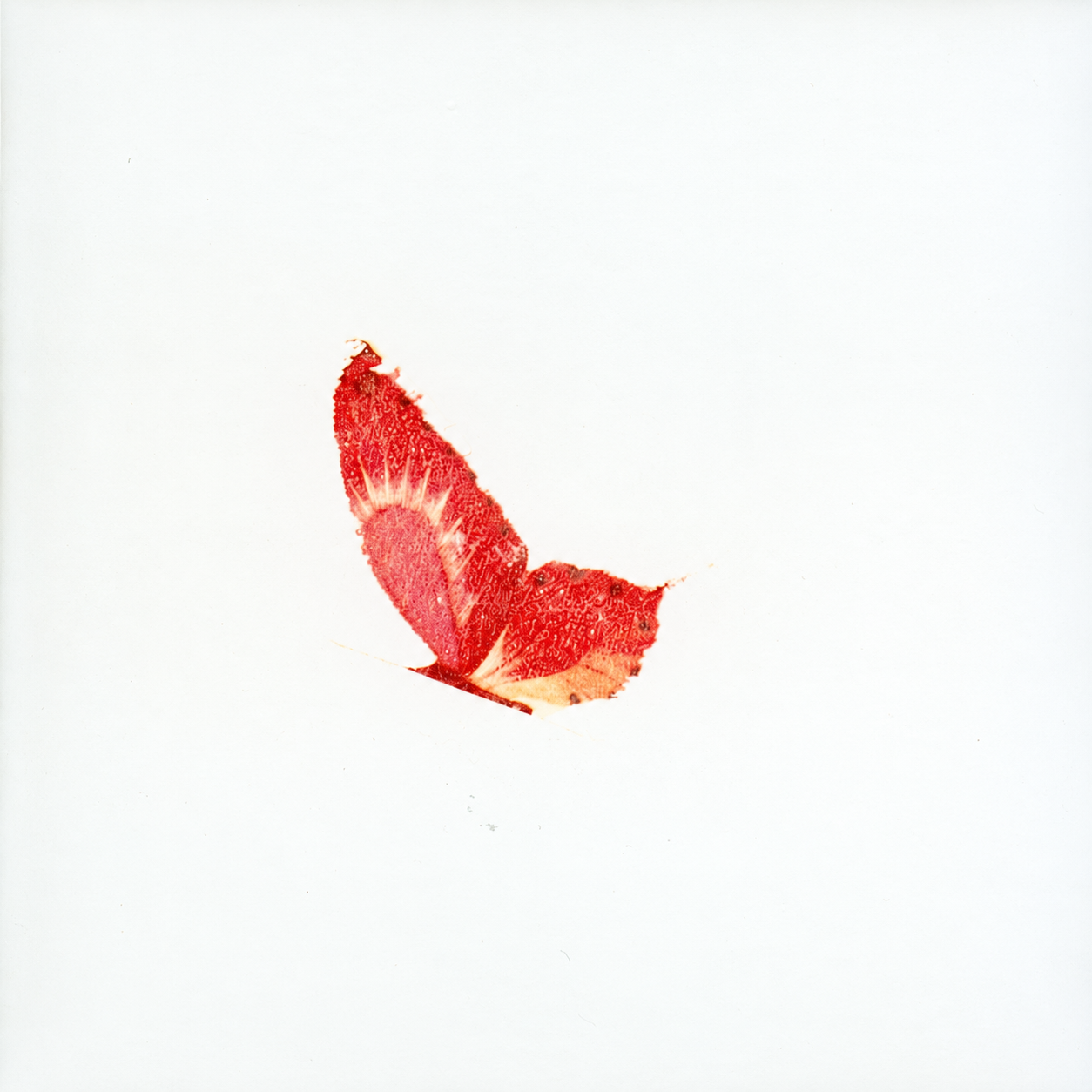
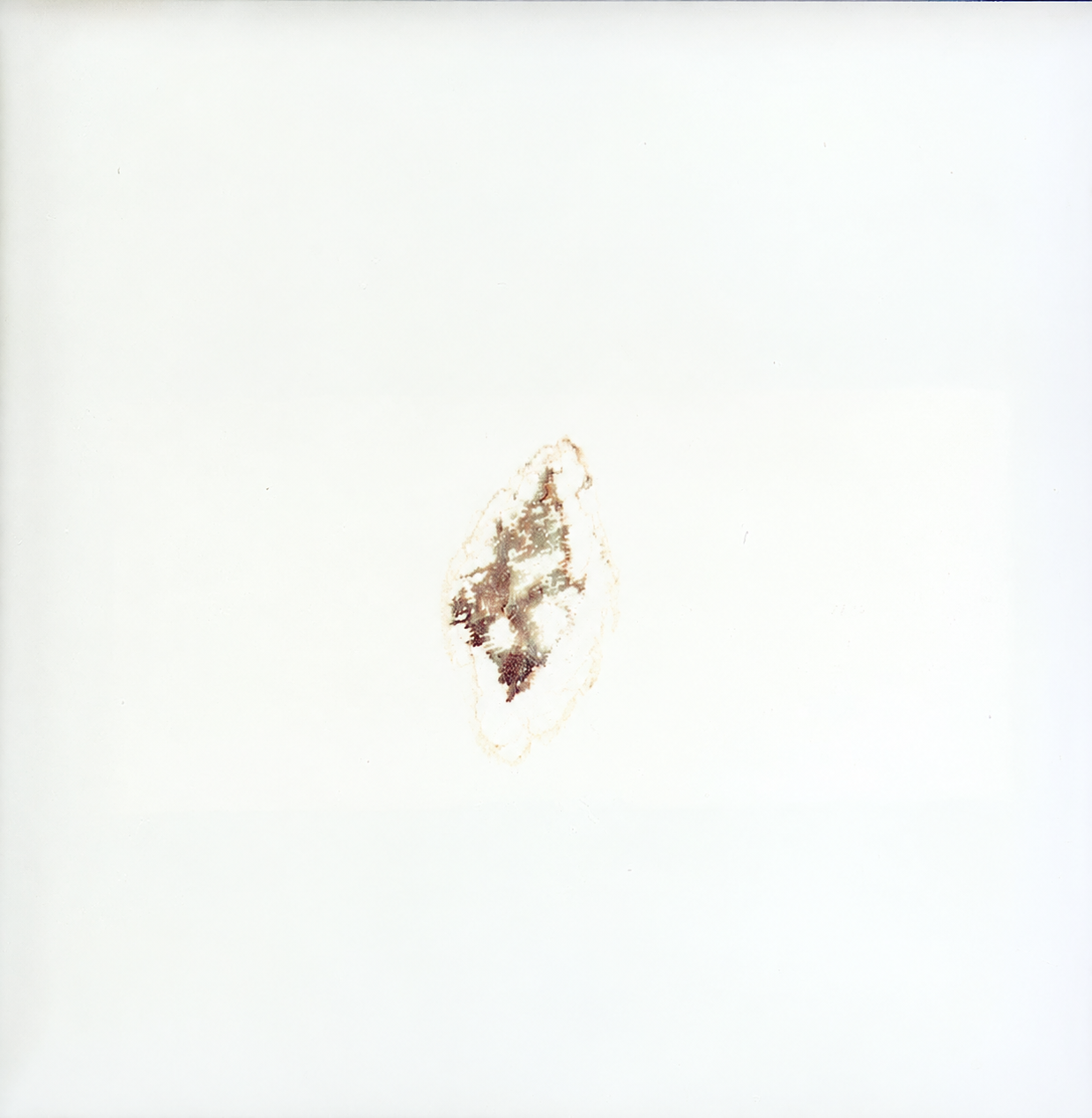
Kitchen tile no. 2 (12 × 12 cm)
Kitchen tile no. 2 (12 × 12 cm) · from the series Frammenti domestici tra memoria e oblio / Domestic Fragments between Memory and Oblivion (1999–2001)
Kitchen tile no. 5 (12 × 12 cm)
Kitchen tile no. 5 (12 × 12 cm) · from the series Frammenti domestici tra memoria e oblio / Domestic Fragments between Memory and Oblivion (1999–2001)
Kitchen tile no. 4 (12 × 12 cm)
Kitchen tile no. 4 (12 × 12 cm) · from the series Frammenti domestici tra memoria e oblio / Domestic Fragments between Memory and Oblivion (1999–2001)
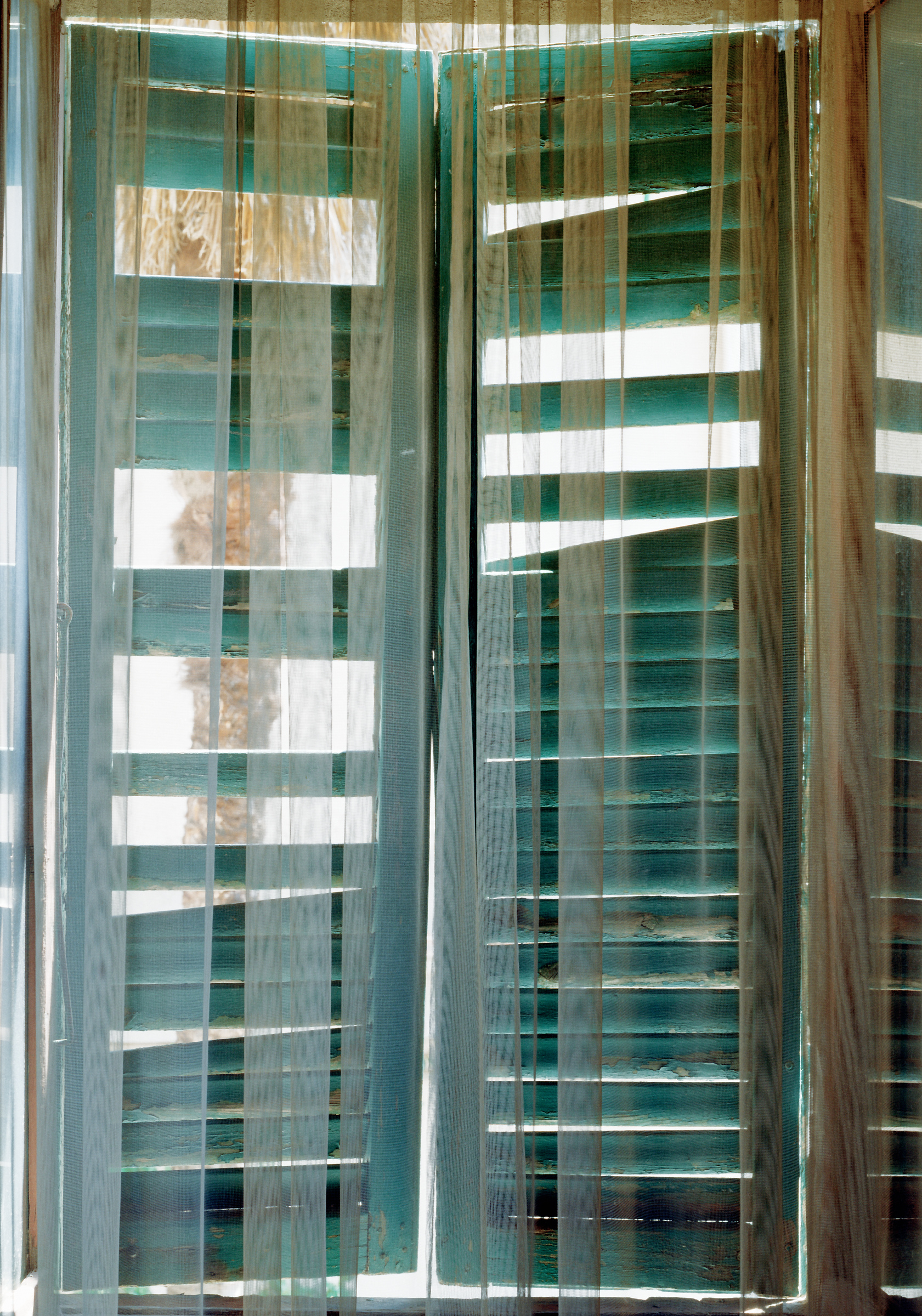
Finestra della mia camera / Window of My Bedroom · Chianciano
Finestra della mia camera / Window of My Bedroom · Chianciano · from the series Frammenti domestici tra memoria e oblio / Domestic Fragments between Memory and Oblivion (1999–2001)
Bathroom wall to the left of the skylight (50 × 60 cm)
Bathroom wall to the left of the skylight (50 × 60 cm) · from the series Frammenti domestici tra memoria e oblio / Domestic Fragments between Memory and Oblivion (1999–2001)
Bathroom wall above the washbasin (21 × 40 cm)
Bathroom wall above the washbasin (21 × 40 cm) · from the series Frammenti domestici tra memoria e oblio / Domestic Fragments between Memory and Oblivion (1999–2001)
Living-room balcony parapet (46 × 58 cm)
Living-room balcony parapet (46 × 58 cm) · from the series Frammenti domestici tra memoria e oblio / Domestic Fragments between Memory and Oblivion (1999–2001)
Kitchen wall to the left of the balcony door (128 × 102 cm)
Kitchen wall to the left of the balcony door (128 × 102 cm) · from the series Frammenti domestici tra memoria e oblio / Domestic Fragments between Memory and Oblivion (1999–2001)
Bedroom wall opposite my grandmother’s bed (102 × 85 cm)
Bedroom wall opposite my grandmother’s bed (102 × 85 cm) · from the series Frammenti domestici tra memoria e oblio / Domestic Fragments between Memory and Oblivion (1999–2001)
Bathroom wall above the bathtub (58 × 46 cm)
Bathroom wall above the bathtub (58 × 46 cm) · from the series Frammenti domestici tra memoria e oblio / Domestic Fragments between Memory and Oblivion (1999–2001)
Wall of my parents’ bedroom with the headboard, at dusk (38 × 49 cm)
Wall of my parents’ bedroom with the headboard, at dusk (38 × 49 cm) · from the series Frammenti domestici tra memoria e oblio / Domestic Fragments between Memory and Oblivion (1999–2001)
Floor of my bedroom beneath the window (56 × 70 cm)
Floor of my bedroom beneath the window (56 × 70 cm) · from the series Frammenti domestici tra memoria e oblio / Domestic Fragments between Memory and Oblivion (1999–2001)

Texts

Mariadele Conti

Emotional interiors

Gigliola Foschi

Photographs of memory and proximity

Roberto Signorini

The photographic and memory, objects and their ‘other’

Alessandro Vicario

Domestic fragments between memory and oblivion

Introduction

Domestic Fragments Between Memory and Oblivion

Fragments domestiques entre mémoire et oubli

Back to Selected Works

Photograph

Emotional interiors

by Mariadele Conti

English

Looking at Alessandro Vicario's photographs, one feels inside the image, finding oneself in the slightly cold light coming through the still windows, perceiving the smells of the empty house and the usual silence of deserted rooms. Everything is motionless and suspended in a gesture of contemplation. But, as happens when we wake up in an unusual place, and the strangeness dissolves when we look around and focus on the surroundings, so with these images, after just a few moments, we recognize that those places and details, so wisely selected by Vicario, are part of everybody's life. Far from being just virtuous esthetical compositions, as they might appear to an inattentive gaze, these photographs let transpire the emotions these spaces are loaded with, and immortalize them, going beyond the merely, purposely autobiographical significance, to reach an emphatic charge that affects us all. These “emotional interiors” are not just spatial representations; they are rather fragments of a life narrated by often impalpable traces, by small things that discretely invite us to imagine the person who might have inhabited those places. And through them, Vicario makes us wish we had met that person ourselves. The “Design Department” of the Centro Arti Visive Pescheria opens its 2006 program with this beautiful photographic exhibition, which focuses in its own way on the topic of “home” and wishes to offer a moment for reflection to those working on home design. Because the images of inhabited places - that is, of design objects - offered by Vicario's interior photographs are quite different from the glossy, advertisement-like pictures we usually see in interior design and architectural magazines. Vicario introduces us to an emotional dimension, to a perception of space and objects that is not just physical and that, in my opinion, should always be at the root of every true project. 

Pesaro, 2007

Photographs of memory and proximity

by Gigliola Foschi

English

News and images multiplying on top of each other, then dissolving into a confused, restless vortex. Faces that speak to us and yet remain indifferent, ready to disappear from our memory in a flash. Background noises amplifying until they cover every single bit of silence. Our society moves rumbling forward, as if outstretching to swallow the past, experiences engraved in time, small memories, affections that cannot be turned into profit. And still, in no other time contemporary art – as if crossed by a stubborn desire of resistance – has so often insisted on memory and committed itself to the recovery of the past, to the creation of silent spaces where one can hear again the humming of things, even of the seemingly more trivial ones. Inside the magical, protective circle of this art, clamour and haste seem to be banished, time suspended. And there’s room again for ancient, outdated questions such as: “How can we cope with the loss of a beloved person? How can we preserve the memory of his/her life after his/her death?”. Alessandro Vicario asks himself these questions and discovers that the material trails left by the life of his beloved grandmother, who recently passed away, are bound to vanish soon: the house in Milan, where she spent her last years, is about to be sold and taken over by new tenants, and the old summer house in Chianciano, where he spent long summer months with her, will also soon be renovated, whitewashed and cleaned. Thus, before it’s too late, Alessandro Vicario returns to those two houses, by now bare, almost completely emptied of their furniture but not yet of the traces of a life and of time, deposited on the walls, on the floors, on the doorposts. With care and patience he observes objects, signs, shadows once partially hidden by use. There, on a wall painted in light-blue, he discerns the mark of a painting that has been taken down; on the entrance door, he notices that time has almost imprinted his grandmother’s surname into the wood … In the softened silence of the deserted house, he photographs with meticulous care these small traces of a beloved existence, in an obstinate attempt to fix every memory, every trace of what she has lived through. His accuracy, his attentive, scrupulous gaze, make his art of photographing akin to Ishiuchi Miyako’s, the Japanese artist. In her work Mother’s (1), this author takes a series of close ups of her mother’s body and, after her death, matches them with the objects that belonged to her, taken one by one: a petticoat, a hairbrush with some hairs still tangled in it, a pair of worn-out shoes, a set of false teeth, a powder-compact, an almost consumed lipstick … Objects which Ishiuchi Miyako, like Alessandro Vicario, frames in an analytical way, with extremely accurate, frontal foregrounds, much like portraits. Perhaps this need (expressed by some contemporary photography) to become a tenacious instrument of connection knows no borders, since both, the Italian and the Japanese, use photography as a means of capturing reality, with the aim of not letting any of the memories hidden inside objects slip away. Neither of them seems to be interested in a descriptive, comprehensive vision, or in creating images where subjective interpretation prevails, but rather in photography as reception, proximity, closeness. Composed by images that are almost fragments, their works are able to transform what they portray into an intense presence, mute and eloquent at the same time. A presence which narrates not just the contingent history of a single life or house, but imposes itself instead as shared memory of a generation’s past. Ishiuchi Miyako’s work restores, for instance, her mother’s figure, but also the memory of a woman who has collected the stories and thoughts of those who have lived through the turmoil of post-war Japan. “By recounting a personal loss, Ishiuchi leads us to share it as a collective loss that echoes inside us, immersed as we are in the hardness of the present, thus sowing the seeds of memory” writes Kasahara Michiko, curator of the Tokyo Museum of Contemporary Art (2). By showing us the houses marked by his grandmother’s presence, Alessandro Vicario intensely evokes, more than with any words, the story of a strong bond of affection. Just looking at the series of images faithfully reproducing a doorpost where his grandmother used to record, year after year, the height reached by her young grandson, is enough to make us perceive the intensity of their relationship and, at the same time, to lead us back to our childhood ties. The grandmother’s house itself, so humble and not in the least interested in looking like the interiors shown by indoor architecture magazines, reveals itself in every detail as a place capable of reflecting the story of its inhabitant. A story that’s also the history of a time when consumerism hadn’t yet appeared, when the custom was still in use of protecting even simple, humble objects with thoughtful care. “There was a thin paper,/ blue or red,/ and books were covered/ so they wouldn’t get spoiled”, Alfredo Tamisari writes for instance in his book Francobolli di tempo (Postage stamps of time) (3), in which he recalls his childhood during the Fifties and Sixties. Nothing was meant to spoil quickly, everything had to be lovingly preserved as long as possible. And those constant minding gestures also had the result of lifting the objects from their anonymity, turning them into presences carrying traces of the lives of those who used them. Even schoolbooks, thanks to their homemade covers, reflected the taste and skilfulness of each student (mine, for instance, were immediately recognizable by the slovenliness of the paper folds). In the same way, the house of Alessandro’s grandmother is filled with these small gestures of attention, referring not just to domestic wisdom, but also to the thoughtful soul: each window still has its pleated curtain, the kitchen walls are protected by a white wallpaper that fits with the tiles around the sink, the radiators are equipped with a matching evaporator to restore the necessary humidity... Alessandro Vicario observes the ‘grandmother’s houses’ like a body that carries engraved in it the traces of that life. With his caring gaze, where every object is seen frontally and transformed into an image with the same dimensions as the thing photographed, he imitates that same care his grandmother used to reserve to her world of home and affection. Moved by the desire of keeping alive a world made of objects and signs doomed to disappear, he gathers visual fragments like a persevering collector, pricking up his ears to listen to the silent humming of their voice. And because his gaze doesn’t claim to interpret what it is facing, one realizes that his granting visibility to things doesn’t conceal the aim of capturing them or laying them bare, but just that of preserving them, of rescuing them from oblivion and indifference. Born in a state of concentration, from an exercise, as it were, of safeguarding and subtraction of self, his images, just because they are so close to the objects, so preoccupied with being their exact copy even in their proportions, manage paradoxically to guarantee their remoteness, to guard their mysterious language. The remoteness his images reveal is indeed not just mere distance but a sort of modesty, of care, even of respectful proximity, able to receive the silence that lies at the bottom of and around things, leaving them as though gently immersed in the slow, soft passing of time. “To me, writing always meant picking up from the thick, complex fabric of life some images, some sounds from the world’s noise, and to surround them with silence” writes Lalla Romano in her Nei mari estremi (In extreme seas) (4). In the same way, Alessandro Vicario recollects in the empty space of the house some “visual evidence”, isolates it and plunges it into silence, turning it into a sort of presence-absence that concerns us all. Because by simply transforming things into images, he causes a shift involving and upsetting our own experience. As Maurice Blanchot recalls, when “the object was there, we seized it in the living movement of a comprehensive action - but when it became an image, it became instantaneously elusive, unreal, impassible, no longer the object removed, but this object as representation of removal itself, the presence in its absence, seizable because of its being unseizable, appearing through its disappearance, the return of what doesn’t come back, the alien core of remoteness as the only life and heart of the object” (5). Released from the contingency of reality, objects that have become images open themselves to a paradoxical condition: they offer themselves as presences and, at the same time, they deny themselves to experience and appear as fleeting; they testify to a reality, but they send that reality back to the past; they are perfect copies of the real, and yet they act as metaphors where the visible becomes the presence of the invisible and the sound of life turns into an incumbent silence, an impersonal echo. Blocked as they are in a sort of interval that longs for life but can never reach it, the objects-images seem to lead a mysterious existence of their own, like an oscillating apparition. An apparition that transforms them into an enigmatic field of intensity where anybody can wander, find the traces of their own past again and feel love and compassion for each thing in the world that is doomed to disappear, to die. 

Milan 2005

 1)   Ishiuchi Miyako, Mother’s 2000-2005: traces of the future, Japan Pavilion, 51st International Biennial Exhibition of Modern Art in Venice, 2005. 2)   Kashara Michiko, Ishiuchi Miyako: solchi del futuro, booklet edited by the Japan Pavilion, 51st International Biennial Exhibition of Modern Art in Venice, 2005. 3)   Alfredo Tamisari, Francobolli di tempo. Microricordi (1950-1970) e un racconto breve, edited by the author, Milan, 2005. 4)   Lalla Romano, Nei mari estremi, introduction to the 1996 edition, Einaudi, Turin. 5)   Maurice Blanchot, The space of literature, University of Nebraska Press, 1982

The photographic and memory, objects and their ‘other’

by Roberto Signorini

English

To understand Alessandro Vicario’s Domestic fragments between memory and oblivion ― in order, for instance, not to see them merely as a representation of forms, extracted from the banality of everyday life and dignified by photography ―, it may be useful to begin with the profoundly autobiographical origins and motivations of this work. The author, born in 1968, lived for a long time with his paternal grandmother, Jole: through his childhood and adolescence, he spent a month each year with her in their summer house in Chianciano; later, while at university, he lived with her in Milan, in her modest flat in via Sant’Abbondio, close to the Naviglio pavese. This shared life of a young man facing his first adult experiences and a woman already weakened in her health and conscious of the approaching end is surely unusual in our times; but it is maybe less surprising if that youth doesn’t mean just exuberance and vitality, but also a restless sensitivity, inclined to wonder seriously about the meaning of one’s own life and of the lives of others ― maybe also because of the daily contact with the experience of old age and decay, seemingly so distant and extraneous but brought close through the deep bond with a beloved person. These are also the years when the author, initiated in photography by his father, a skilful professional, begins to see in that fascinating magic a possible tool for self-expression and for the exploration of reality - though avoiding from the very start, thanks to the strict, demanding approach of his training, the easy traps of a rough amateurism. In 1999 his grandmother Jole dies, and her flat is sold and emptied of all that made it a well-known, reassuring landscape; two years later, the house in Chianciano is renovated. In these two occasions, one of which, the first one, is surely heart-rending (but the other one isn’t painless either), the author finds himself confronted for the first time with the disappearance of things that are such a big part of our lives, on whose apparently solid background we are used to projecting our own image and the flow of our vicissitudes. For the first time, he faces the experience of leaving behind a life phase that will never return again. From this situation the need, the imperative even, arises in him of retaining some scrap of what is about to leave the stage of visible and to dissolve in the flow of memories. To this need, which is at the same time intimate and endowed with objective power, he, a graduate in History and thus familiar with its “indirect, presumptive, suppositional […] knowledge”[i], finds an answer in photography as a means “to find clues” and “evidence in the historical process”[ii], as extraction and organisation of traces left by things with the intermediation of light: in this case signs, clues, evidence left behind by a beloved person’s life and by his own, in two houses whose aspect will soon radically change. And, like in history, in archaeology or in the transmission of texts and artworks, where what can be preserved and remembered is always far less than what it used to be, and to make up for the loss one tries to reconstruct a meaning by binding together the scattered remains - so in the case of this private archaeology it is possible, too, to save only part of a whole forever lost, i. e. some domestic fragments to be won for memory and delivered from oblivion; and the gaps will be filled in with the meaning suggested by the combination of fragments in the spaces of an installation, allusive of physical spaces (and life habits, relationships, affections…) that the onlookers will imagine and recreate on the basis of their own experiences and personal archaeologies. This work is the expression of a modern pietas in which, though, “all intimacies are sacrificed to the illumination of detail”[iii]; it derives from a great intensity and emotional urgency, that the author is nevertheless able to control with the rigour of the method and rules he imposes on himself, as if to stem his grief and compensate symbolically for chaos and decomposition with the order and precision of forms. The images are always frontal reproductions of two-dimensional or almost two-dimensional subjects, executed with an optical bench camera permitting the maximum control over geometry and depth of field, printed at a one-to-one ratio with the subject and mounted on rather thick panels. But the austere technique is not just self-control, and the minute restitution of the subjects is no illusionist game: the images, offering themselves to the onlookers with a physical presence that brings them close to the real things, suggest they should be looked at as at finds saved from destruction and recomposed, even though fragmentarily, in a space evoking their lost context. Here the author finds himself in syntony with a number of artistic researches of the last thirty years[iv]. Setting out from a personal exigency, he relives and appropriates on impulse the rich history of experiences and reflections that in the 20th century - between avant-gardes and neo-avant-gardes, theorists of the Twenties-Thirties and of the Seventies-Nineties (with behind them the birth of semeiotics at the beginning of the century) - unrolled around the idea of the photographic, i.e. the idea of a peculiar image that suggests not only a representation but also a presence; not just an icon or resemblance of reality but also an index or trace of it[v]; not so much reality reproduced by our hand as reality producing itself before our eyes. An idea that, becoming more and more explicit as it progresses from the handprints of prehistoric caves to the classical myths of Narcissus and the maiden of Corinth, to the medieval legend of Veronica and the modern obsession with a self-painting or self-drawing representation, ripens at last in that “drawing produced by light” that is photo-graphy, and from there is relayed further in much contemporary artistic practice[vi]. This result, though, is strictly connected not just with a long vicissitude of the past, but also with a specific condition of the present: in the capitalistic present, relationships between people appear as relations between things, and things are in their turn subtracted from full perception by being reduced to goods, to the abstraction of the mere exchange value[vii]. Thus in the world of the universal reification, “all of our experiences end up in the ambit of the ‘unconsciously automatic’ […]. The object passes us by as if packaged; we know what it is by the place it takes, but we only see its surface”, and “life disappears, turning into nothing”[viii]. Hence the discovery of the value of art as opposition, with the goal of “restoring the meaning of life” and of “transmitting the impression of the object as ‘vision’ and not as ‘recognition’”; a goal it achieves through “the process of ‘estrangement’”, that is “the transposition of the object from its usual perception to the sphere of a new perception, […] delivered from automatism”, because there “the […] ‘vision’ […] is created ‘artfully’, in a way that makes perception linger over it, thus reaching its highest possible force and duration”[ix]. So the paradox comes true that, just through the rediscovered adhesion to perceptive materiality, to the here-and-now of things, art refers “to something else […] than what is immediately expressed by single tangible forms, but, at the same time, to ‘another’ content within the same forms”[x]; it hints at a transcendence that is wholly earthly, and yet alternative to the pretension of capitalistic reification to present itself as the only possible world. This is the art that carries out “the salutary estrangement between man and his surroundings. It gives free play to the politically educated eye”[xi]: the eye that knows well that, in a reified world, “everless a mere restitution of reality tells of reality”, because that reality is by no means innocent: to regain a relationship with it, one must instead “construct something, something artful, arranged”[xii], and this is what “photographic construction”[xiii] does, with its extracting and recomposing, decontextualizing and recontextualizing fragments of reality. This kind of photography is centred on things, not to invite us to exchange them and consume them, but to re-educate our gaze by estranging it, by releasing it from the automatism of exchange and consumption, by showing us the possibility of redeeming those same things as presences charged for us with significance, with human relationships not reduced to wares. This is for me the meaning of Domestic fragments by Alessandro Vicario, and of the consistent progress of his research through Screpolature. Dal muro di Berlino (Cracks. From the Berlin Wall, 2003), Paesaggi d’assenza. Sulle tracce di Lalla Romano (Landscapes of absence. In the tracks of Lalla Romano, 2003), Borghi abbandonati in Val Borbera (Abandoned villages in Val Borbera, 2005)[xiv]: all works where the collection of photographic traces of things leads to the more than ever present problem of memory, never before so denied or abused and never before such an unavoidable, historical, ethical and esthetical question, where the reasons of autobiography acquire a “hidden political significance”[xv], that of the story and the choices of us all. 

Milan 2005

[i] Carlo Ginzburg, “Clues: Roots of an Evidential Paradigm”, Hutchinson Radius, London (1990) 
[ii] Walter Benjamin, “The Work of Art in the Age of Its Technological Reproducibility” (1936): “[…]incomparable significance of Atget, who, around 1900, took photographs of deserted Paris streets. It has quite justly been said of him that he photographed them like scenes of crime. The scene of a crime, too, is deserted; it is photographed for the purpose of establishing evidence. With Atget, photographs become standard evidence for historical occurrences, and acquire a hidden political significance.”.    
[iii] Walter Benjamin, “A small history of photography” (1931): “In these images [Atget’s; see note 2] the city is deserted, like an apartment that hasn’t found its new tenants yet. It is in these achievements that […] photography […] sets the scene for the salutary estrangement between man and his surroundings. It gives free play to the politically educated eye, under whose gaze all intimacies are sacrificed to the illumination of detail.”.  
[iv] One example for all: the works of Christian Boltanski.
[v] Charles S. Peirce, Collected Papers, Cambridge (Mass.), Harvard University Press, vol. 2
[vi] See Philippe Dubois, L’acte photographique, Paris/Bruxelles, Nathan/Labor (1983)  
[vii] Karl Marx, Foundations of the Critique of Political Economy (“Grundrisse”) (1857-1858, publ. 1939), engl. transl. Penguin Classics (1993); Capital: a critique of Political Economy, book 1 (1867), engl. transl. Penguin Classics (1993) (Chapter 1, Section 4, “The fetish character of the commodity and its secret”)  
[viii] Viktor Šklovskij, “Art as process” (1917), in Theory of prose (1925), engl. edition 1990  
[ix] Ibid.  
[x] Remo Bodei, Le forme del bello, Bologna, Il Mulino, 1995  
[xi] See note 3.
[xii] Bertolt Brecht, “From the three penny trial: a sociological experiment” (1931), quoted in W. Benjamin, “A small history of photography”
[xiii] W. Benjamin, “A small history of photography”: a construction that, as Benjamin points out, “is a merit of the surrealists”.
[xiv] Part of this work has been published in: VV. AA., Atlante Borbera 2005, Edizioni R.U.R.A.L.I.A., Milano, 2005.
[xv] See note 2.

Domestic fragments between memory and oblivion

by Alessandro Vicario

English

  The time deposited on house walls and inside us. The time of gaze and memory. The time of oblivion. Immaterial dimensions of experience that reveal themselves through tangible traces, that the photographic representation transfigures, transforms into signs. Signs of days lived through; of days remembered; of days forgotten (or doomed to be forgotten).   Signs of somebody dear to me: my paternal grandmother, who dwelled among those walls for more than forty years. I lived with her for a while, on the fourth floor of a council house in Via Sant’Abbondio in Milan. Five years: the last ones of her long life. I isolated some fragments of the house, bare by then, and turned them into ‘visual evidence’. They recall the ambience they’ve been ‘drawn’ from, just as archaeological finds remind of people, places, events of the past. I photographed the house shortly after my grandmother’s death in January, 1999. Her flat had been almost completely cleared of its furniture: the resulting emptiness, besides exposing things hidden before, had filled itself with absence. I had returned to the house with my photo equipment, intending to photograph the doorpost on which my grandmother and my parents used to mark the progress of my growth when I was a child. Checking the dates, one would notice that the measurements were almost always taken on a Saturday. Every Saturday my father came to pick me up from school and we went to have lunch at my grandmother’s place. Then I stayed with her the whole afternoon. At dusk, I was seized by melancholy. And when my father or my mother came to fetch me at night, parting from my grandmother brought tears to my eyes. And when I had quarrelled with her – which happened sometimes – parting was even sadder. As I said, I had gone back there to photograph the doorpost. But walking through the empty, silent rooms, I became aware of the many traces of life that the absence of furniture had revealed or made more manifest. I was deeply impressed by them. The grief from my recent loss was intense, but it sharpened my senses and made memories more alive (and heartbreaking) than ever. And so it happened that, after photographing the doorpost, I started taking pictures of another detail, and then another, and another... For over a week I went back there every day, and every day I stayed there from morning till evening. I observed, remembered, waited for the best light, and photographed. Without haste, concentrating on things that remain in the background of everyday life and usually don’t get much attention, but that photography can convert into signs charged with symbolic values and emotional echoes. The flat in Via Sant’Abbondio has since then been sold to a young woman. It has been renovated and modernized. Those walls, branded by life and time, don’t exist anymore. Their traces remain in the memory of a few and in the emulsion of some tens of photographic plates. Later on, my parents decided to modernize the old house in Chianciano, Tuscany, where I used to spend part of my summer holidays as a child and as a boy with my grandmother. That house was special. Located in the heart of the old town, in ‘Chianciano paese’, as it used to be called (in opposition to Chianciano Terme, the new part): a wide flat with high ceilings, exposed beams and thick walls, on the ground floor of an apartment house that once hosted the convent of the Franciscan Sisters, adjoining the collegiate church. There is still something cloistral about the shared lobby, and the solemn voice of the organ resounds through the apartment when mass is celebrated in the church close by. The thought that those walls would be cleaned up and whitewashed, and the floors replaced, led me to carry on there the research I had already undertaken in Milan. And so the second part of the Domestic fragments was born. It had been years since I was in Chianciano. I went there in the summer of 2000 and then again in the summer of 2001. I chose the summer to find the atmosphere and the light of that time again. We always went there between July and August; never once did we go there in another season. Now of those walls and floors, too, there’s nothing left but the uncertain traces of human memory and those, just as precarious, of photographic memory.   The images forming Domestic fragments aim at being true reproductions of the portions of world they represent. I worked with a large format camera, my father’s old Linhof Technicardan: an instrument that supports meticulous accuracy and guarantees the fine restitution of details. Still, paradoxically, the faithful reproduction of some fragments of reality, isolated from their context, transfigures reality itself: the photographically reproduced objects appear as something new, almost unexpected. And it is just this different, renewed vision of what seemed known and familiar, that is for me one of the reasons for the fascination and expressive power of photography.       

Milan, November 2005

Fragments domestiques entre mémoire et oubli

Introduction · Français

Focalisée sur les thèmes de la mémoire et de la perte, la recherche d’Alessandro Vicario n’est pas vouée à ennoblir formes et objets de la vie quotidienne à travers la photographie, mais à réorganiser les traces et les indices du passé à travers lesquels on peut arriver à reconstruire une histoire, qu’elle soit un évènement historique ou la vie d’une personne. Grâce à une méthode rigoureuse qui prévoit la reproduction frontale et préfère le bidimensionnel à la profondeur de champ, l’artiste transforme les fragments du réel en signes photographiques avec le but de les sauver de la destruction vers laquelle ils seraient forcément destinés. Les oeuvres d’Alessandro Vicario révèlent une grande force évocatrice et se caractérisent par l’absolue précision du détail et, en imposant au spectateur leurs présences physique par le moyen d’une impression à l’échelle du sujet, nous obligent à imaginer leur contexte, les usages et les relations qui ne sont pas intrinsèques à l’oeuvre mais seulement suggérés. “Fragments domestiques entre mémoire et oubli “(Domestic Fragments, between Memory and Oblivion) est née d’une urgence émotionnelle et de l’exigence de retenir quelque chose qui était en train de partir ; le travail est réalisé à l’intérieur de la maison de la grand-mère paternelle décédée récemment. Les repères visuels qu’Alessandro Vicario prélève des ambiances nous renvoient à des personnes et des événements passés et reconstituent d’authentiques archéologies personnelles exposant le regard à une absence douloureuse. En revanche, on retrouve dans les signes laissés par le temps et dans un espace désormais presque complètement vide, les éléments essentiels qui permettent à l’artiste d’affirmer sa propre identité. 

Domestic Fragments Between Memory and Oblivion

Introduction

Centred on memory and loss, Alessandro Vicario’s research does not seek to ennoble the forms and objects of everyday life through photography. Rather, it reorganises the traces and clues of the past through which a story can be reconstructed, whether it concerns a historical event or a person’s life. Through a rigorous method that involves frontal reproduction and favours two-dimensionality over depth of field, the artist transforms fragments of reality into photographic signs, seeking to save them from the destruction to which they would otherwise inevitably be destined.

Alessandro Vicario’s works have a powerful evocative quality and are distinguished by their absolute precision of detail. By asserting their physical presence before the viewer through prints made at the scale of the subject, they compel us to imagine their context, uses and relationships, which are only suggested rather than contained within the work.

Fragments domestiques entre mémoire et oubli / Domestic Fragments Between Memory and Oblivion arose from an emotional urgency and a need to hold on to something that was slipping away. The work was made inside the house of the artist’s paternal grandmother, who had recently died.

The visual clues that Alessandro Vicario draws from these surroundings evoke people and events of the past, reassembling genuine personal archaeologies that confront the gaze with a painful absence. Yet the marks left by time, within a space now almost entirely empty, also contain the essential elements that allow the artist to affirm his own identity.

Search